
ICICI Bank, HDFC Bank, IndusInd Bank down between 0.2%-1.4% each.

From the Sensex pack, Nestle, Tata Steel, Tata Motors, Bharti Airtel, Larsen & Toubro, Power Grid, NTPC, Tata Consultancy Services, Tech Mahindra, Infosys and Axis Bank were the major gainers. Kotak Mahindra Bank, Maruti, Bajaj Finance, Mahindra & Mahindra and ICICI Bank were the laggards.

The government should scrap the windfall profit tax on domestically produced crude oil as the levy is adversely impacting the capex-intensive exploration of oil and gas, the industry said in its recommendation for the forthcoming annual Budget. India first imposed windfall profit taxes on July 1, joining a growing number of nations that tax super normal profits of energy companies. At that time, a Rs 23,250 per tonne ($40 per barrel) windfall profit tax on domestic crude production was levied.

The Reserve Bank of India's interest rate decision, domestic macroeconomic data and global trends will dictate terms in the equity markets this week, analysts said. Trading activity of Foreign Portfolio Investors (FPIs) will also influence markets, they added. "The Indian market will be closely monitoring the Reserve Bank of India's Monetary Policy Committee (MPC) meeting scheduled for June 6-8, 2023. Aside from that, market participants will be keeping an eye on the progress of monsoon," said Pravesh Gour, Senior Technical Analyst, Swastika Investmart Ltd.

Among the Sensex firms, Larsen & Toubro, UltraTech Cement, JSW Steel, Titan, Bajaj Finance, Wipro, Tech Mahindra and Nestle were the major laggards. Maruti, Power Grid, Axis Bank, State Bank of India, NTPC, HDFC Bank, ITC and IndusInd Bank were the gainers.

Rising crude oil prices, traction in China equities and inflation concerns back home are casting a shadow on the Indian equity markets in the short term, believe analysts at Jefferies. They said this could see the markets remaining range-bound in the near term before the next leg up.

Snapping its declining trend, retail inflation rose to a three-month high of 5.55 per cent in November on firming food prices, including vegetables and cereals, though it remains within the RBI's comfort zone of less than 6 per cent. Inflation based on the Consumer Price Index (CPI) was 4.87 per cent in October and 5.88 per cent in November 2022, the government data released on Tuesday showed. The previous high was 6.83 per cent in August and inflation had been on a decline since then.

Government had proposed a revised investment plan for the main gas fields in the KG-D6 block.

Renewed inflationary pressures, led by a spike in prices of vegetables and cereals, have cast a spell on the equity markets in the past month. The BSE Sensex and Nifty50 have declined up to 2 per cent each during the period, clipping the 13 per cent rally from the March lows, shows data from ACE Equity. Investors typically consider shares of fast-moving consumer goods (FMCG) companies as defensive bets, putting their weight behind them in a falling market.

Oil and Natural Gas Corporation has made five oil and gas finds in eastern offshore and north-east, the most significant being a gas discovery in the Mahanadi basin block where 3-4 trillion cubic feet of gas reserves have already been established.

The comment was in response to a June 19 Reuters story citing sources with knowledge of the matter as saying that India planned to clear some oil payments to Iran through the United Arab Emirates central bank.

Capital expenditure (capex) by 54 large central public sector enterprises (CPSEs) and five departmental arms with an annual capex target of Rs 100 crore and above has reached around 42.5 per cent of their annual target of about Rs 7.33 trillion in this financial year so far, a senior official from the Ministry of Finance told Business Standard. "The Centre is pushing the big public undertakings in the infrastructure and refinery sector to achieve 90 per cent of their target by the end of the third quarter," he said. The capex by this group of CPSEs stands at around Rs 3.1 trillion in the April-August period so far.

'We suggest an equity strategy of 5% to 10% exposure to cash, 5% to Gold ETF, close to 50% to Sensex/Nifty/large mid-cap stocks.'

The Reserve Bank on Thursday marginally revised upwards the economic growth projection for the current fiscal to 6.5 per cent, from its earlier estimate of 6.4 per cent. Unveiling the first bi-monthly monetary policy of 2023-24 fiscal, RBI Governor Shaktikanta Das said the GDP growth in the first quarter of 2023-24 is expected at 7.8 per cent.

Reliance Industries on Friday said that it has made a sixth oil discovery in the Gujarat block, but did not give the reserves that the latest find may hold.
Britain's Cairn Energy Plc has struck oil and gas in Rajasthan, the fourth discovery by the British firm, in the block which borders Gujarat.

Benchmark interest rate hiked by 50 basis points to 3-year high at 5.90 per cent. Economic growth projection for FY23 cut to 7% from 7.2% estimated in August. GDP expected to grow at 6.3% in September quarter, 4.6% each in December and March quarters.
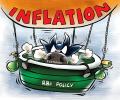
The Reserve Bank on Wednesday projected inflation to come down below the upper threshold level of 6 per cent by March quarter of the current fiscal. RBI Governor Shaktikanta Das said the central bank will keep 'Arjuna's eye' (focus) on the evolving inflation dynamics and will remain 'nimble and flexible' to deal with the price situation. Global commodity prices, including crude oil, have undergone some downward correction, but uncertainty continues to surround the near-term outlook in view of the prolonging geo-political hostilities. Moreover, the resurgence in domestic services sector activity could also lead to price increases, especially as firms pass on input costs.

Prices may go up because of higher energy costs, caused by the rise in shipping charges, with commercial vessels taking a longer route to avoid the troubled Red Sea region, the finance ministry said on Monday. Iran-backed Houthi rebels of Yemen are repeatedly attacking ships in the Red Sea. While the global economy is grappling with challenges such as sticky inflation, sluggish growth, and mounting fiscal pressure, India's external sector could face "potential risks" due to the ongoing geopolitical tensions, according to the finance ministry's report on the review of the Indian economy.

Benchmark equity indices Sensex and Nifty closed higher by more than half a per cent on Wednesday following buying in IT, financial and oil stocks after the RBI slowed down the pace of interest rate hikes. Ending its two-day slide, the 30-share BSE Sensex rebounded by 377.75 points or 0.63 per cent to close at 60,663.79 with 24 of its constituents posting gains. The broader Nifty of the NSE spurted by 150.20 points or 0.85 per cent to settle at 17,871.70, riding on a rally in Adani Enterprises, Adani Ports and HDFC Life.

India's rupee is likely to remain under pressure due to high prices of crude oil and other commodities, and may stabilise at around 79-80 against the US dollar in the near term, say experts amid limited headroom available with the Reserve Bank to check the weakening of the domestic currency. The currency has slumped over 5 per cent this year after Russia's invasion of Ukraine sent international crude oil prices soaring to a decade high. On Monday, rupee ended at a fresh all-time low of 78.34 (provisional) against the US dollar.

Pradhan said a National Data Repository which will store information on all sedimentary basins of the country is being pursued on top priority.

After selling dollars for the past few months, the Reserve Bank of India (RBI) may take a hands-off approach before its annual account closing by not trying to prop up the rupee as geopolitical tensions show signs of stabilising with global crude oil prices easing from its $140 peak. The central bank was a net buyer of dollars between April and September, and then turned a net seller in the following months, the data released by the RBI showed. The RBI continued to be a net buyer of $36.6 billion in this fiscal year - between April and January. In 2020-21, it purchased $68 billion on a net basis.

Among major Sensex shares, PowerGrid fell the most by 2.76 per cent. IndusInd Bank dropped 2.34 per cent, HUL by 2.23 per cent and NTPC by 2.04 per cent. ICICI Bank, HDFC Bank, HDFC, ITC, Infosys, L&T, Bajaj Finance, Kotak Bank, HCL Tech and Tech Mahindra were among the losers. On the other hand, Tata Motors rose the most by 2.94 per cent, followed by Titan which gained 1.26 per cent. Mahindra & Mahindra, SBI and TCS were also among gainers.

In the Sensex pack, Mahindra & Mahindra, Tata Steel, Tata Motors, Maruti, Larsen & Toubro, HDFC, HDFC Bank, Tech Mahindra and Bharti Airtel were the major laggards. Asian Paints, Bajaj Finserv, Power Grid, Reliance Industries, NTPC and UltraTech Cement were among the gainers.

India will pay Iran $900 million in two tranches beginning next week to clear part of the past dues for crude oil it buys from the Persian Gulf nation.

Oil prices continued their rout on Tuesday with Brent crude and U.S. WTI both falling to their lowest in almost six years as a big OPEC producer stood by the group's decision not to cut output to tackle a glut in the market.

Oil fell below $59 a barrel for the first time since May 2009 on Tuesday, extending a six-month selloff as slowing Chinese factory activity and weakening emerging-market currencies added to concerns about demand.

A stronger dollar makes oil more expensive because it raises the cost for imports for most of the world's countries
State-owned Gas Authority of India Ltd has discovered oil and gas near Ahmedabad, in onshore block awarded under the exploration policy.

Retail inflation fell to a 15-month low of 5.66 per cent in March, mainly due to a decline in food prices, government data showed on Wednesday. The inflation figure in March is within the RBI's comfort zone as it is below 6 per cent. The retail inflation based on Consumer Price Index (CPI) was 6.44 per cent in February 2023 and 6.95 per cent in the year-ago period.

Equity benchmarks ended modestly higher on Friday after the Reserve Bank raised the key interest rate in an effort to cool stubbornly high inflation and defend the rupee. Continuous foreign fund inflows into the capital markets and softening crude oil prices also helped the bourses regain momentum, traders said. The 30-share BSE Sensex ended 89.13 points or 0.15 per cent higher at 58,387.93 after facing volatility during the fag-end of trade. During the day, it climbed 350.39 points or 0.60 per cent to 58,649.19. The broader NSE Nifty went up by 15.50 points or 0.09 per cent to finish at 17,397.50.
As global tensions put pressure on the cost of crude oil, sending petrol prices above 1 a litre across the UK, This is Money investment writer Philip Scott investigates how investors can profit from rising oil prices.

From the Sensex pack, IndusInd Bank, NTPC, Asian Paints, Hindustan Unilever, JSW Steel, Tech Mahindra, Bajaj Finance, Infosys, Wipro, ICICI Bank, Bajaj Finserv, HDFC Bank and Tata Motors were among the major laggards. HCL Technologies, Power Grid, Titan, Reliance Industries, UltraTech Cement, Tata Steel, State Bank of India and Mahindra & Mahindra were the gainers.
Pushing a barrel of oil back to around $100 would require a reduction of production of about two million barrels a day - a cut that would fall predominantly on Saudi Arabia.
OVL, which has a 20 per cent stake in the oil field in Russia's far east, currently gets around 38,000 barrels of oil per day of the total production of 190,000 barrels per day. OVL's share is expected to fall to 32,000 barrels even as the overall production from the field is likely to come down to 160,000 barrels from next year. OVL, a 100 per cent subsidiary of India's biggest oil producer, paid $1.7 billion for a 20 per cent stake in Sakhalin I.
